
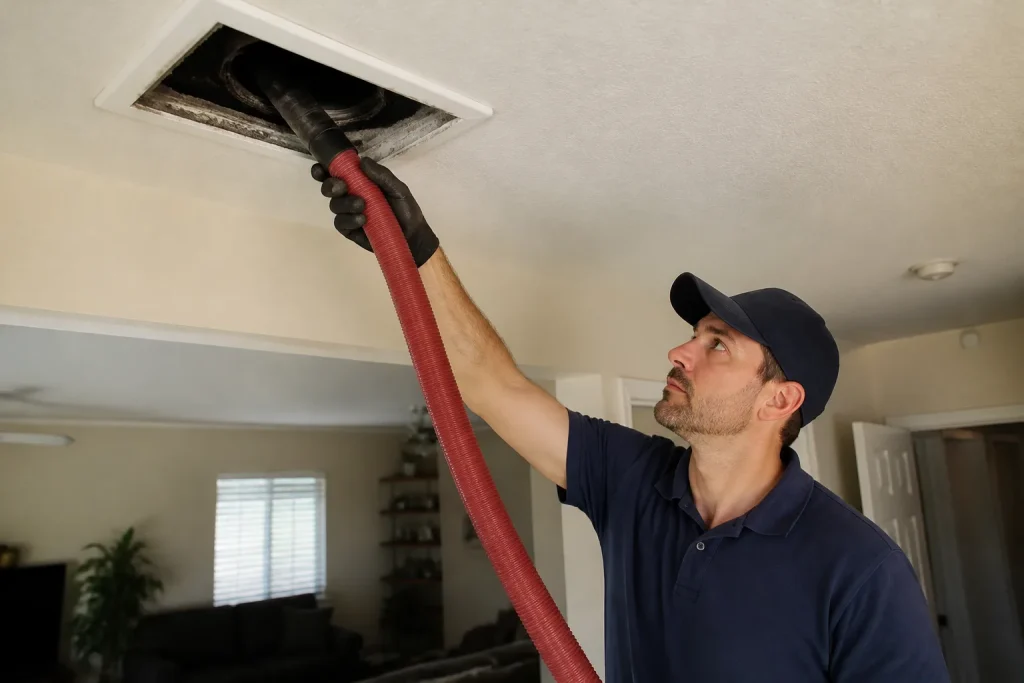
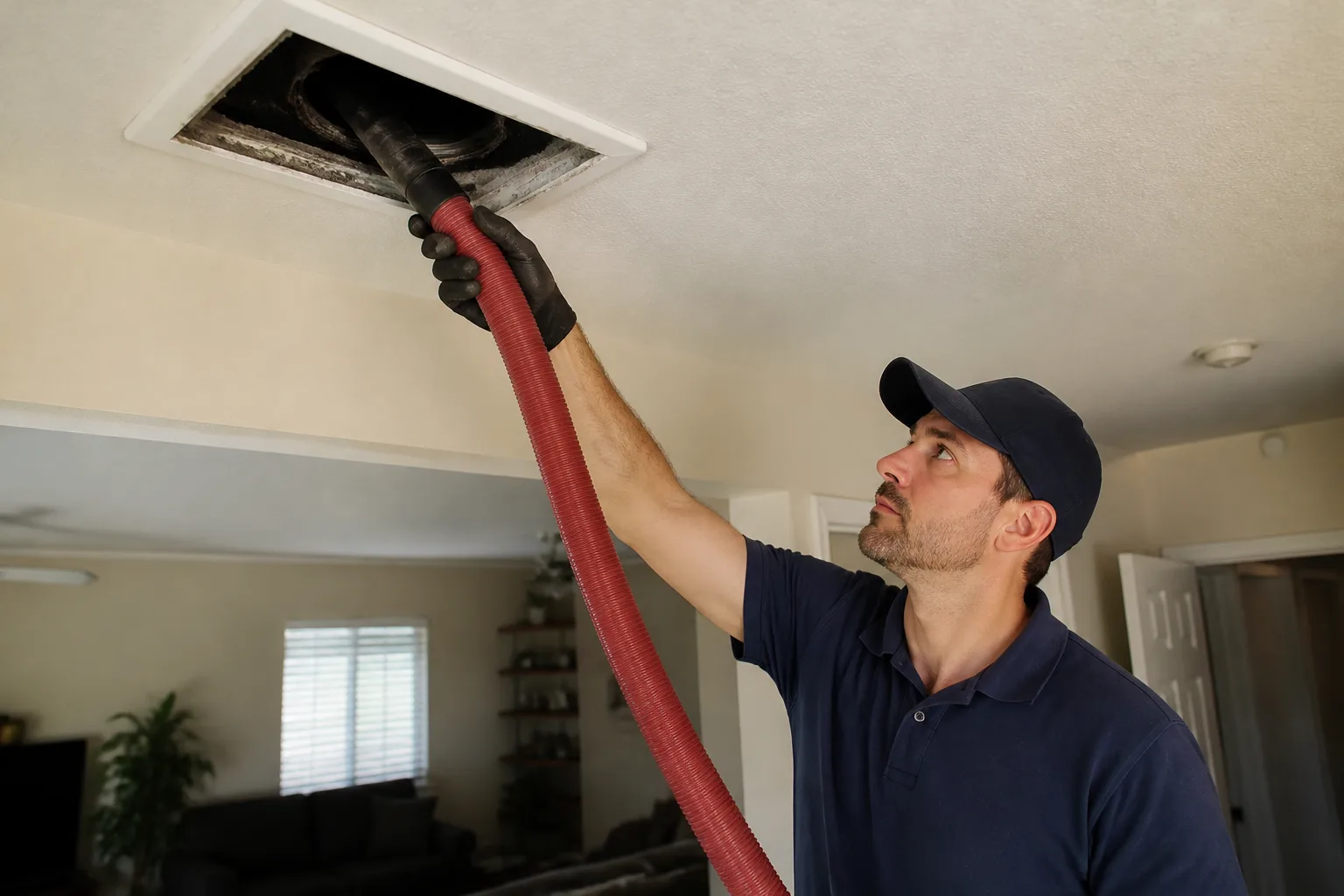
Emergency Air Duct Cleaning Near Me: What Pocket Homeowners Should Do First
If you’re searching for emergency air duct cleaning in Pocket, the honest answer is this: most urgent situations need a different first step before anyone touches your ductwork. True duct emergencies fall into three narrow categories – confirmed rodent activity in the system, soot distribution after an HVAC fire, or sewage contact near return vents. If you smell something burning or suspect a cracked heat exchanger, skip the duct cleaning search, shut down your system, and call an HVAC or gas professional immediately.
That said, if you’re dealing with a genuine duct contamination issue, Purevent Air Duct Cleaning is ready to respond. Call (877) 752-5088 and we’ll walk through your situation before we even schedule anything.
Key Takeaways:
- Post-flood duct cleaning must wait until the ducts are dry – cleaning wet ducts spreads mold.
- Three scenarios justify same-day or next-day service: rodent contamination, HVAC fire soot, or sewage near returns.
- The smell from your vents isn’t always a duct problem – it could be a dead animal, a dirty coil, or a combustion issue.
- A proper emergency duct cleaning still takes several hours if done right.
The Three Scenarios That Actually Justify Emergency Duct Service
Pocket homes, especially the older ones along Riverside Boulevard and the newer builds further south toward Meadowview, all share the same three genuine duct emergencies. Here’s what warrants a same-day or next-day call.
1. Confirmed rodent infiltration. If you’ve trapped a rat or mouse in your Pocket home and found droppings near a floor register, the contamination is inside your duct system. Rodent waste dries, becomes airborne, and circulates through every room. This is a health issue, not a comfort preference. The ducts need contact-based cleaning with a rotary brush, not a vacuum pass. Reputable companies will also inspect for chewed flex duct sections – which brings us to repair capability, something Purevent handles during the same visit.
2. HVAC fire with soot distribution. A furnace or air handler fire, even a contained one, pushes fine soot through the supply and return network. That soot carries combustion byproducts. You cannot paint over it or run the system until it burns off. The duct surfaces need mechanical agitation to release the soot, followed by negative-air extraction to capture it. This is where our Nikro negative-air machines do exactly what remediation contractors rely on them for.
3. Sewage backup near return registers. If a sewer line backed up in a Pocket crawlspace or a bathroom adjacent to your return air path, aerosolized sewage particles may have entered the system. This is rare, but when it happens, the return side needs full cleaning and sanitizing before the air handler runs again. In these cases, we also inspect for water-damaged insulation inside the duct runs themselves.
Anything outside these three scenarios is probably not an emergency. It might be urgent to you – we understand that – but scheduling it as a normal service call is usually the right move.
Why Post-Flood Duct Cleaning Should Wait Until Things Are Dry
This is the mistake we see most often in Pocket after heavy winter rains or a burst pipe: a homeowner calls for immediate duct cleaning while the ductwork is still wet. Here’s the problem, stated plainly. Cleaning wet ducts spreads contamination instead of removing it.
Water inside ductwork creates the exact environment mold needs – dark, still, and full of food in the form of dust. Running a rotary brush through wet ducts smears the moisture and any existing microbial growth across a wider surface area. The brush agitates, but without dry conditions, you’re inoculating more of your system rather than cleaning it.
The correct sequence for flood-affected ductwork is:
- Stop running the HVAC system entirely.
- Extract standing water from visible duct sections and the air handler area.
- Set up high-volume airflow (a negative air machine works well here) to dry the system from inside.
- Take moisture readings with a probe at multiple points along the duct runs.
- Only when readings confirm dry conditions should contact cleaning begin.
If a company offers to clean your ducts the same day as a flood without checking moisture first, that’s a red flag. A proper response includes drying, then cleaning, then verifying. It might take an extra day or two. That’s how it has to be.
What to Do in the First Hour When You Suspect Contaminated Air
Let’s say you’ve just discovered the problem. Droppings in a vent, soot around a register, or a sewer smell coming from the return grille in your Pocket living room. Here’s the first-hour protocol that prevents the problem from spreading.
Step 1: Kill the air handler. Switch your thermostat to “off” or cut power to the furnace or air handler at the breaker. Running the system pulls contaminated air through the ducts and pushes it into every room. Do this before anything else.
Step 2: Seal the returns. Cover return grilles with plastic sheeting and painter’s tape. This prevents ambient contaminated air from being drawn into the system while you decide on next steps. Leave supply registers alone for now – sealing them can redirect airflow oddly if the system accidentally comes back on.
Step 3: Ventilate the affected area. Open windows in rooms where you suspect contamination. Run a standalone fan blowing out if you have one. This creates a pressure differential that pulls airborne particles outside rather than letting them settle back into carpets and upholstery.
Step 4: Document everything. Photos of what you found, where you found it, and the condition of the registers. This helps any company you call understand the scope before they arrive.
Step 5: Call for a diagnosis. This is the step most people skip. They call for cleaning when they should call for someone who can assess. At Purevent, we start with questions over the phone: what you saw, where, whether there’s been recent water, recent pest activity, or any HVAC repair work. That conversation determines whether we dispatch immediately, schedule for later, or point you toward a different professional entirely.
And if you’d rather not deal with any of this yourself, call (877) 752-5088. We’ll talk it through with you.
Is That Smell a Duct Problem, a Dead Animal, a Dirty Coil, or Something Worse?
Pocket homeowners call us about odors more than any other symptom. The hardest part is that smells from a vent can come from four entirely different sources, and only one of them is solved by duct cleaning.
Dead animal in the system. This has a specific signature – a sharp, organic, foul smell that gets worse when the fan first kicks on, then fades slightly. It’s often localized to one or two registers. The source is usually a rodent that entered through a damaged vent or a gap in the flex duct. Removal requires locating the carcass, extracting it, and sanitizing the affected section. Duct cleaning alone won’t fix it. Duct repair might be needed to close the entry point.
Dirty evaporator coil. A sour, musty smell that’s strongest at the start of cooling season, coming from multiple registers, points to your coil. The coil sits above the air handler and collects moisture, dust, and sometimes microbial growth. Your ducts may actually be fine. A technician needs to inspect the coil directly. General HVAC companies handle coil cleaning; Purevent can inspect and let you know what’s actually going on.
Dusty or contaminated ducts. A persistent stale, dusty, or slightly sour smell that’s consistent no matter the season suggests buildup in the duct runs themselves. This is what contact-based cleaning addresses. We use Rotobrush rotary-brush systems to physically scrub the duct interiors, paired with negative-air extraction to capture what the brushes dislodge.
Gas or combustion odor. If you smell something like rotten eggs, burning plastic, or exhaust fumes, shut everything down and call your gas utility or an HVAC technician with combustion expertise. This is not a duct problem. Do not run the fan. Do not wait. Gas smells in a Pocket home are a life-safety issue first and everything else second.
The takeaway: before you schedule cleaning, figure out which smell you have. If you’re not sure, start with a phone consultation. We’d rather spend ten minutes on the phone ruling out a gas issue than have you wait on a cleaning that won’t fix the real problem.
What Real Emergency Duct Cleaning Actually Looks Like
“Emergency” and “thorough” usually don’t go together. Duct cleaning is one place where they have to. A proper job, even under urgent circumstances, still takes several hours. Here’s what a reputable company should do during an emergency-grade cleaning in a Pocket home.
Assessment first. Before any equipment gets set up, a technician should inspect the system: the air handler, visible duct runs, registers, returns, and any accessible crawlspace sections. This determines whether cleaning is feasible or whether repairs need to happen first. During a rodent contamination job, for example, we sometimes find chewed flex duct that needs replacement before cleaning makes sense.
Containment during work. Professional-grade negative-air machines create negative pressure inside the duct system while cleaning happens. This means dust and debris get pulled into the machine’s filtration, not pushed into your home. Our Nikro negative-air units are the same type used in mold remediation and HVAC restoration work. If a company is using a shop vac pointed at a register, that’s not emergency cleaning – that’s adding more dust to your house.
Contact-based agitation. Every duct run gets worked with a rotary brush system from Rotobrush. The rotating brushes scrub the interior surfaces to dislodge what’s adhered there. Vacuum suction alone doesn’t do this. Adhesion matters – that’s why contact cleaning is the difference between a surface pass and an actual clean.
Repair and inspection included. During the cleaning process, a good technician is looking for structural problems: disconnected sections, crushed flex, gaps at joints, or deteriorated inner liners. Purevent’s air duct repair service means we can fix those findings right then. Most duct-cleaning-only companies note them on an invoice and leave you to find another contractor. Your duct system is only as clean as the repair it needs.
Verification. After the work, we show you what came out and what got fixed. Before-and-after photos of the registers and problem areas give you confidence that the system is actually clear. That’s the kind of evidence a research-minded homeowner in Pocket should expect.
One real example: we pulled a blown-out section of flex duct out of a crawlspace in a home near Garcia Bend Park last fall. The homeowner had called about a musty smell. What we found was a disconnected return pulling unfiltered crawlspace air. Cleaning wouldn’t have solved it. Repair did.
When to Call a Pro (and When to Wait)
Here’s the decision framework in plain terms.
Call a professional duct specialist right away if:
- You’ve confirmed rodent activity and see droppings near or inside registers.
- You had an HVAC-related fire and there’s soot visible around supply vents.
- You’ve had sewage or graywater contact near your return air path.
- You see visible debris actively blowing out of your registers.
Schedule a normal cleaning when:
- There’s dust buildup at your registers but no other symptoms.
- Allergies flare up seasonally and you haven’t cleaned in several years.
- You’ve just completed a renovation that generated heavy drywall dust.
- You bought an older Pocket home and want a clean baseline.
Call someone else entirely if:
- You smell gas, exhaust, or burning plastic. Call your utility or an HVAC combustion specialist.
- Your carbon monoxide detector is going off. Leave the house and call 911.
- You have active standing water from a current flood. Call a water mitigation company first.
Related services in Pocket: If you need help with lint buildup in your Dryer Vent Cleaning in Pocket, that’s a separate safety concern we handle too. And if your duct inspection reveals damage, our Air Duct Repair in Pocket service covers it during the same visit.
The Bottom Line
Emergency air duct cleaning in Pocket is real, but it’s narrower than most people assume. The genuine emergencies are rodent contamination, fire soot in the system, and sewage near returns. Everything else, including post-flood ductwork, should follow a controlled sequence: stop the system, dry it out, verify it’s dry, then clean. A reputable company will help you determine which path applies before scheduling anything.
Purevent Air Duct Cleaning offers free estimates and honest phone consultations. If you’re in Pocket and suspect contaminated air is moving through your ducts, call (877) 752-5088. We’ll help you figure out what’s actually urgent, what can wait, and what needs a different call altogether. Our Air Duct Cleaning in Pocket service covers residential systems with professional-grade equipment and the repair capability most cleaning companies don’t have.
Frequently Asked Questions
Emergency air duct cleaning in Pocket typically ranges from $450 to $900 for a whole-home system, depending on the size of the home, the severity of contamination, and whether repairs are needed. Rodent remediation jobs tend to run higher because they require sanitizing, not just cleaning. We don’t do per-vent pricing or teaser quotes. You get one flat price for the entire system, agreed before any work begins. Call (877) 752-5088 for an exact quote – estimates are free.
Only after the fire source is fully extinguished, the home has been ventilated, and any structural cleanup is underway. Duct cleaning addresses soot and particulate inside the duct runs. It doesn’t address smoke embedded in drywall, carpet, or insulation. In most cases, duct cleaning happens near the end of fire remediation, not the beginning. That sequencing matters if you want results that last.
A thorough emergency duct cleaning in a typical Pocket home takes four to eight hours, depending on the size of the system and the nature of the contamination. Rodent jobs that include sanitizing and repair can run longer. Be suspicious of any company that claims a full-system emergency clean in under two hours. That’s not contact cleaning. That’s a vacuum pass.
Usually yes. For routine cleaning, you can stay. For rodent or sewage contamination, we may recommend staying out of the immediate work area during the agitation phase, especially if you have respiratory sensitivities. The negative-air equipment runs throughout the process to pull contaminants into filtration, not into your living spaces. We’ll tell you before we start if we think stepping out is wise.
Written by the team at Purevent Air Duct Cleaning, serving Pocket.
Need Air Duct Cleaning Help?
Call Purevent Air Duct Cleaning - licensed & insured, with free written estimates in Pocket.
(877) 752-5088