
Abatement Technologies Air Duct Cleaning in Pocket: A Homeowner’s Guide
Abatement Technologies equipment in residential duct cleaning matters because it was never designed for residential work. The company builds negative-air machines and HEPA filtration units for asbestos abatement, mold remediation, and hospital containment projects – environments where a filtration failure has regulatory and legal consequences. When that same equipment shows up in a Pocket home, it means the contractor is applying a contamination-control standard to your ductwork that most residential cleaning companies don’t bother with. If you’d rather not sort through equipment specs yourself, call Purevent at (877) 752-5088 and we’ll walk you through exactly what we run and why.
What Abatement Technologies Actually Builds (And Why It’s Different)
Most duct cleaning vans carry a portable vacuum unit that shares DNA with a shop vac. Abatement Technologies builds something else entirely: high-volume negative air machines paired with certified HEPA filtration, originally engineered for commercial remediation jobs where workers are pulling asbestos fibers or mold spores out of occupied buildings. The design priorities are different. A residential vac optimizes for portability and low cost. A remediation unit optimizes for filtration integrity, sustained negative pressure, and debris containment over hours of continuous operation.
In practical terms, here’s what that means for a Pocket homeowner:
- Filtration class: Abatement units typically run HEPA filters rated at 99.97% capture efficiency at 0.3 microns. That’s the particle size where standard consumer filters fall apart – but it happens to be exactly the range where fine dust, mold spores, and allergen particles live.
- Air volume: These machines move air in the hundreds to thousands of CFM (cubic feet per minute), not the dozens a portable vac manages. That sustained airflow is what pulls debris through the entire duct run, not just the first few feet from the register.
- Containment logic: Remediation equipment is designed to exhaust filtered air safely – either outdoors or back into the space after HEPA scrubbing. Cheaper units recirculate whatever they don’t catch right back into your living room.
The vacuum sitting in most duct cleaning vans was built for residential convenience. Abatement Technologies builds theirs for environments where containment failure has regulatory consequences. That’s not a minor distinction – it’s the whole point of this post. Purevent’s Air Duct Cleaning in Pocket service runs this class of equipment because we’d rather over-filter than under-deliver.
The Filtration Gap: What Standard Units Miss
When a homeowner asks us why equipment matters, we usually start with particle size, because it’s easy to visualize. A human hair is about 70 microns thick. The dust you can see on a shelf is typically 10 microns or larger. But the particles that trigger allergy flare-ups, asthma episodes, and that stale, heavy feeling in a closed-up Pocket home in August? Those run between 0.3 and 3 microns – small enough to stay suspended in air for hours, pass through most standard filters, and settle deep in your lungs.
A basic duct cleaning setup with a standard filter bag will catch visible debris. That’s not nothing. But it misses the fine fraction: dander, pollen fragments, mold spores in the 1 – 5 micron range, and the breakdown products of dust mites. HEPA-rated filtration at 99.97% efficiency at 0.3 microns is the standard Abatement Technologies builds to, because that’s the standard required in hospital isolation rooms and abatement containments.
Here’s the honest caveat: HEPA filtration in a duct cleaning rig doesn’t mean your ducts become sterile. Ductwork isn’t a cleanroom. What it means is that the fine particulate load – the stuff you can’t see but your sinuses can feel – gets captured and contained rather than aerosolized back into the house. In a Pocket home where the windows have been closed since June and the HVAC has been cycling the same air for four months, that distinction is real.
Why Negative Pressure Matters More Than You’d Think
You’ll hear the term “negative air” thrown around by duct cleaners in Sacramento County. Most homeowners nod and don’t ask what it actually means. Here’s the translation: negative pressure is what happens when the extraction unit pulls more air out of the duct system than can flow back in passively. The ductwork goes into a slight vacuum state. Debris doesn’t just get sucked toward the hose – it gets pulled through the entire duct run, because the whole system is flowing toward the extraction point.
The alternative is what we call “contact-only” cleaning. The vacuum creates enough suction to grab material near the hose head, but the far reaches of the duct run stay largely undisturbed. The technician brushes what they can reach and calls it done. The homeowner sees a clean register and pays the invoice. Six months later, the dust is back, because the debris load in the trunk line was never actually removed.
Sustained negative pressure requires two things: enough CFM to overcome the static pressure of the duct system, and enough filter surface area to maintain airflow as the filter loads with debris. This is where equipment class becomes obvious. A unit rated at 100 CFM with a single small filter will choke as soon as it starts pulling dust. A negative-air machine rated at 500 – 1,000 CFM with staged filtration keeps pulling consistently through a full residential system. In our experience cleaning Pocket homes – many of them 70s and 80s builds with long trunk runs and multiple branches – the difference in what comes out of the far registers is dramatic.
The Pocket-Specific Angle: Aging Flex Duct and Extraction Strategy
Pocket has a particular housing profile. A large share of the homes in this neighborhood went up between 1975 and 1995, and many still have the original flex duct they were built with. Flex duct is a spiral wire coil wrapped in insulation and a plastic vapor barrier. After 30 or 40 years, the inner liner degrades. It gets brittle. The vapor barrier tears. The insulation settles. None of that is the homeowner’s fault – it’s just what time does.
What this means for cleaning is that aggressive mechanical agitation carries risk. Shoving a stiff metal brush down a 40-year-old flex duct run can tear the liner, separate the inner core from the insulation, or pull a section loose from its collar. That’s not a cleaning problem anymore; it’s an Air Duct Repair in Pocket problem. Now the homeowner is paying for a repair that wasn’t necessary before the cleaning started.
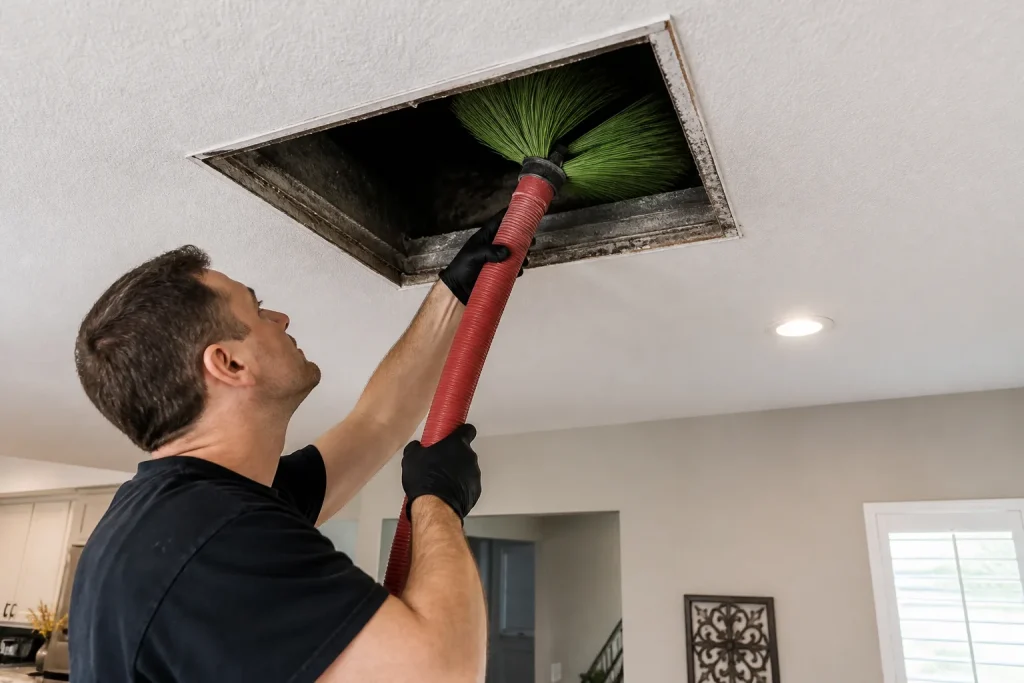
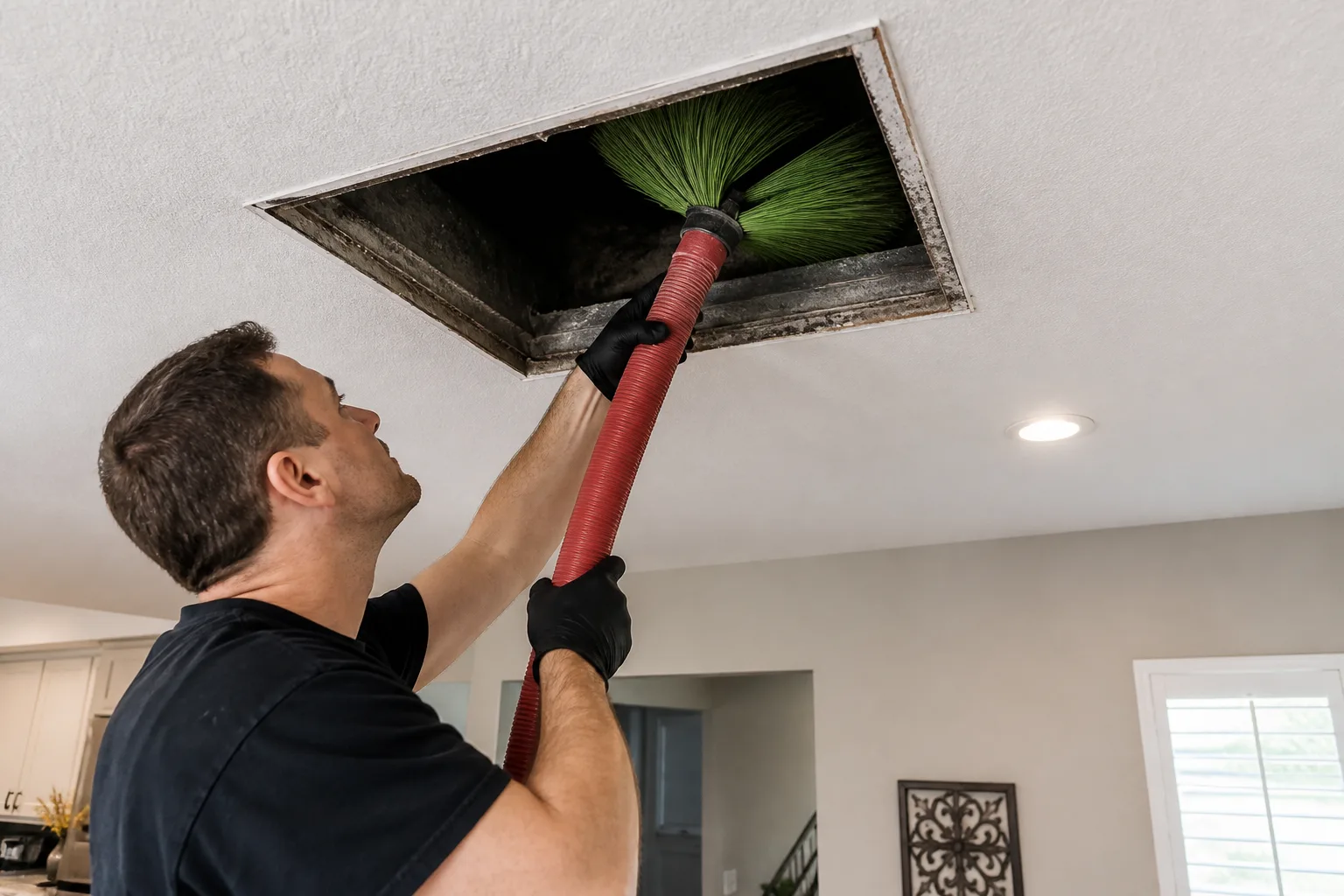
The smarter approach on aging flex duct is low-trauma, high-volume extraction. A rotary brush that makes light contact, paired with strong negative air so debris is pulled out rather than pushed around. The Abatement Technologies philosophy fits here: sustained airflow does the work, while mechanical contact stays gentle. We’ve pulled surprising material out of original 1980s duct runs in Pocket without touching the liner – because the extraction was doing the job, not the abrasion.
If you know your home still has original flex duct, mention that when you’re getting quotes. Any contractor worth their invoice should adjust their approach based on duct age and material. If they don’t ask, ask yourself why.
What to Ask Any Duct Cleaner About Their Equipment
You don’t need to become a filtration engineer to make a smart hiring decision. Ask these five questions. A reputable contractor answers them without blinking. Watch what happens when you ask the cheap-bid operators.
- What’s the CFM rating on your extraction unit? You want to hear a number in the hundreds, not the dozens. If they don’t know the rating, that’s an answer too.
- What filtration class does the unit run? Listen for “HEPA” followed by a specific efficiency percentage. “Good filters” is not a specification.
- Does the unit exhaust outdoors or recirculate filtered air indoors? Outdoor exhaust means whatever gets past the filter isn’t staying in your living room. Recirculation is acceptable if the filtration is genuinely HEPA-grade; it’s not acceptable on a standard bag filter.
- How do you adjust your method for older flex duct? This tells you whether they’re thinking about your specific house or just running the same script everywhere.
- Can you do air duct repair if you find damage during cleaning? If the answer is no, you’ll be coordinating a second contractor when – not if – the cleaning turns up a disconnected section or a torn liner. Purevent handles cleaning, inspection, and repair in the same visit because we’d rather hand you one invoice and a finished system.
One more question worth asking: “What happens if I want to see what came out of my ducts?” A legitimate operation shows you the collection chamber. If the answer is vague, call someone else.
How Abatement-Grade Equipment Fits Into a Full-System Approach
Equipment is one variable in a larger equation. A HEPA-grade negative air machine paired with a technician who doesn’t understand duct layouts or airflow dynamics is still a wasted afternoon. The equipment and the operator have to work together, which is why reputable companies standardize both.
In our operation, Abatement Technologies filtration gear runs alongside Rotobrush rotary-brush systems for contact cleaning and Nikro negative-air machines for system depressurization. Honeywell and Guardsman components show up in filtration and containment details. None of these brands is magic on its own. Together, they cover the full sequence: agitate the debris, extract it under negative pressure, filter the exhaust to HEPA standard, and inspect the result. When we find a problem – a disconnected section, a crushed flex run, a leaking plenum – we fix it on the spot because duct repair is part of our service, not a referral to someone else.
This is the difference between a cleaning crew and a full-system specialist. A cleaning crew makes the accessible parts look better. A specialist understands that your duct system is only as clean as the repair it needs. Both have a role. Homeowners in Pocket who want the first visit to be the only visit tend to call the second type.
Related Services in Pocket
If you’re dealing with ductwork, there’s a good chance you should also look at your dryer vent. We run a dedicated Dryer Vent Cleaning in Pocket service because dryer vents are a fire risk, not just a performance issue. Lint accumulates, airflow drops, the vent gets hotter, and the National Fire Protection Association has been pointing at dryer vents as one of the most preventable household fire sources for years. The job takes less time than duct cleaning, but it’s arguably more important for safety.
What happens when you call
- 1
A real person answersNo phone trees – you reach a local pro.
- 2
You get an upfront price rangeHonest numbers before anyone is dispatched.
- 3
A background-checked tech heads outLicensed & insured, dispatched right away.
- 4
You approve before work beginsNothing starts until you say go.
When to Call a Pro
Here’s the honest threshold. If your registers are blowing visible dust when the system kicks on, if you’re changing filters every month and they’re still caked, if certain rooms never reach the set temperature, or if you can’t remember the last time anyone looked inside the ductwork – call a pro. Duct cleaning is not a DIY job. The equipment required to do it properly costs more than most homeowners will ever spend on a single project, and the damage you can do to aging flex duct with a rented shop vac and a drill attachment is real. We’ve seen the aftermath: torn liners, collapsed sections, insulation pulled into the airstream. It’s cheaper to call first than to repair second.
The Bottom Line
Abatement Technologies equipment raises the bar for residential duct cleaning because it applies remediation-grade filtration and negative pressure to a job most companies approach with consumer-grade tools. That translates into finer debris capture, more complete extraction through the full duct run, and a gentler touch on aging flex duct – all of which matter more in Pocket, where much of the housing stock is old enough to have original ductwork still in service. When you’re comparing quotes, ask about CFM, filtration class, and exhaust strategy. If the contractor can’t answer, keep looking. If you’re in Pocket and want a straight answer about what’s in your ducts, Purevent Air Duct Cleaning offers free estimates – call (877) 752-5088.
Frequently Asked Questions
Abatement Technologies builds negative-air machines and HEPA filtration systems designed for asbestos abatement, mold remediation, and hospital containment work. In residential duct cleaning, their equipment matters because it filters at 99.97% efficiency at 0.3 microns – the particle size range where allergens, mold spores, and fine dust live – and it moves enough air to pull debris through the entire duct run rather than just the area near the vacuum hose. Call (877) 752-5088 to ask what equipment we run and why.
In Pocket, CA, air duct cleaning with professional-grade equipment typically runs $400 – $900 for a full system, depending on home size, number of registers, and duct condition. Homes with original 1970s – 1990s flex duct may cost slightly more due to the care required. Exact pricing depends on your system – call (877) 752-5088 for a free estimate, and we’ll give you one flat price per system before work starts, not a per-vent teaser.
No, and any contractor who claims that is overselling. HEPA filtration captures the fine particulate fraction – the 0.3-micron range that includes mold spores, pollen fragments, and allergen-carrying dust – and prevents it from being recirculated into your home during the cleaning process. It’s a containment standard, not a sterilization guarantee. It does, however, remove the fine debris load that standard consumer filters miss entirely.
Yes. Pocket has a large stock of homes built between 1975 and 1995, many with original flex duct that has degraded over time. Aggressive mechanical brushing on brittle flex duct liners can cause tears, separation from the collar, or insulation pull-through. The right approach pairs light-contact rotary agitation with high-volume negative air, so extraction does the work without stressing the liner material. If your home has original ductwork, tell the contractor before they start – call (877) 752-5088 and we’ll adjust the method accordingly.
Written by the team at Purevent Air Duct Cleaning, serving Pocket since 2017.
Need Air Duct Cleaning Help?
Call Purevent Air Duct Cleaning - licensed & insured, with free written estimates in Pocket.
(877) 752-5088